

The stories in this volume compose FAB = -FBA, SUM FLUX V.2.3 See more stories, and check out the authors featured in this edition here.
Leaving Paris
I leave behind the city’s breathless crush, seeking the relief of distance.
There are places where silence is not absence but expansion.
I test the weight of memory against the stillness of snow, against the tide of a world moving forward.
I am not just leaving—I am returning.
Central Europe, by train. Latvia waits at the other end.
Eastward bound.
Not a home in the sense of comfort. No. Something heavier: a root system, tangled and half-buried. A country that made me, even if I’d tried to forget all about that.
The ticket sat in my drawer for months, folded and waiting. I booked it one night in a haze of restless fatigue, scrolling through flights and watching prices shift. The moment itself was unremarkable, but the feeling behind it wasn’t—a slow recognition. I could no longer exist in this city. I could no longer pretend.
I board the plane. Exhale.
The Collapse of a City (Paris)
The hollowed-out zones of privacy grind forward despite the streets, in reluctant conjunction with hundreds of invisible hands pulling the Seine through the city’s veins. Paris swells, language fogging the crevices of sleep, suffocating yet endearing.
The overcrowding creeps in, and my faith malfunctions. The city has rewritten itself into something I no longer understand—harder, more angular, like an old face gone gaunt with time. The only way out is out.
The metro stations reek of metal, sweat, and piss, thick air churning beneath fluorescents. Sirens pulse. Shopkeepers slam their shutters down with violent finality, the sound cracking through alleyways slick with last night’s vomit. Shadows shift beneath the scaffolding. Always, men pissing against walls, hunched—defeated soldiers of a war no one remembers.
The city is a machine of exhaustion.
Once, I thought Paris held secrets, that if I moved through it long enough, I would find something unspoken, some meaning embedded in its architecture. But now it is only what it is—a place that takes more than it gives.
I want to slip through, unseen.
Into a darker winter.
Into a series of former selves barking in the Arctic cold.
Into the Baltic Silence
The descent into Riga is slow. The conductor announces the temperature: below freezing.
I step onto the tarmac. The wind does not whip or howl. It holds, pressing inward like hands testing the ribs. The air smells of fuel, wet asphalt, the latent scent of frozen water.
Silence here is not emptiness—it is structure.
Home does not demand a thing.
It does not flood the senses like Paris, does not dictate movement, does not assault the body with insistence. It simply waits, holding its shape.
I feel the tension leave my shoulders, but not in relief. More like a thread snapping.
What the Cold Remembers
Desolation swells in this dark beauty.
Cities promise vitality but strip themselves bare. Beneath the neon arteries and restless movement lies something stark, some ancient function too stripped of ornament to be called beautiful.
Leaving is an experiment: to confront freedom with the dull razor of simplicity. To strip the self of the scaffolding of urgency. To see what emerges in its place.
A man steps off a train. A man confronts the past. Are they the same man?
Icepick winds rake the Baltic Sea, rattling me. My ashes of departure scatter in their grip. Will they settle, or will I be undone?
So much depends on authenticity—the who behind the what.
“The salt-rind left behind the ebbing tide, this relatively free mind . . .”
Freed to walk alone.
Modernity comes with shackles; the wild cuts them loose.
Vilnius . . .
They once prohibited occupation of these Baltic landscapes, for strategic and security purposes. The Red Army’s crude oil needed to flow. That emptiness created a new breed of solitude.
I stand at the edge of the sea, hands buried deep in my pockets, fingers stiff from the cold. The wind off the Baltic is knife-edged, slicing through layers, finding the ribs. The water is steel-gray, churning beneath a sky the color of unpolished metal. Waves roll in slow and heavy, indifferent. No footprints mark the frozen sand.
This place was once closed, forbidden. Now, it is simply forgotten.
I wave goodbye to the past.
I crave silence—not just quiet, but the kind that drowns out even memory.
I look into the white space between these words and glimpse fragments of what has been built to replace the silence.
The Bridge Between Past and Present
Slush and soot. Snow dragged through industrial grime, refusing to disappear.
The wilderness surrenders again to civilization. The exhaust of cars blends into the frozen earth. Northern snow clings to the city as if tethered by latitude, closer to the Arctic’s breath.
Subjugation lingers. The Soviet yoke pressed into its memory, receding but never truly gone.
For some, the past is distant, blurred into nostalgia; for others, it claws at the edges of their thoughts.
Doom hangs like a sword of Damocles, swinging over civilized necks.
Reentry
A slow reintegration. A reluctant return.
The beat is less hollow.
Children’s faces as they are pulled along on sleds to school by their fathers. Mothers linger behind, no longer thinking of gulags.
This fragile affluence somehow resists being punctured by mere fear.
A surreal harmony. True or false—it does not matter. For now, warmth glimmers in the contradictions.
Accordion music threads through a dive bar. It is a warm embrace that does not suffocate or oppress. Moving back home will be dreadful, but this moment numbs reentry.
History unravels in guarded voices. Certain inevitabilities are inescapable, even in dreams.
Here, I build my slow bridge between chaos and silence, between war and peace. Its layers are jagged, its beauty raw. Stories rise and fall with the snowdrifts, fragile and fragmented, waiting to be uncovered beneath the permafrost of history.
What Remains
Nothing is ever fully left behind.
The silence waits beneath the noise. The weight of history lingers beneath the snow.
I cross the bridge back to chaos, but some part of me remains here—buried, waiting for some thaw that may never come.


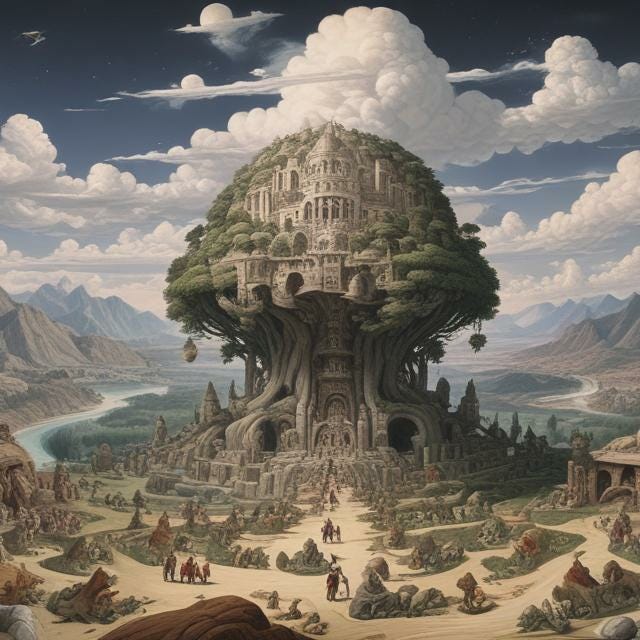

Title image by Jon T
 | A guest post by
|
Remarkable. Each line drew a gasp.
Lovely.